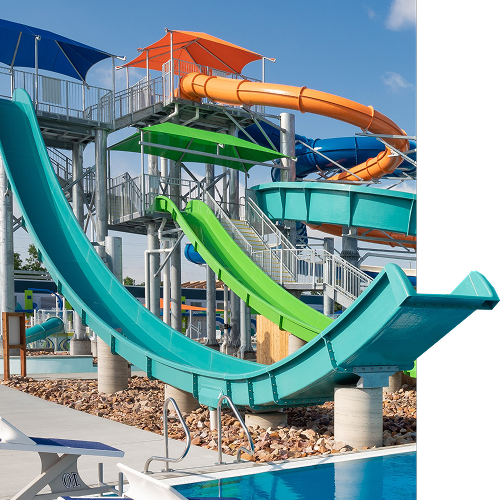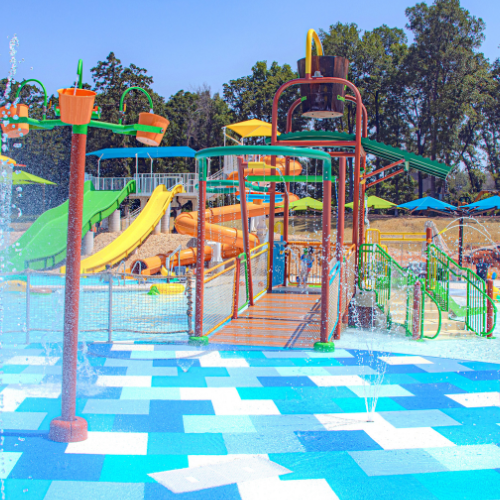
When you picture a summer day at a waterpark, what do you see? Giant tipping buckets dumping gallons of water, kids racing down slides, or families bobbing down lazy rivers, waterparks and aquatic centers are built for one core reason: to give people a place to splash, let loose, and make memories together.
But to make sure that all members of your community get to make those lasting memories, accessibility can’t be an afterthought.
Innovations in aquatic accessibility are moving fast, and best practices are constantly evolving. Whether you’re breaking ground on a brand-new facility, planning a slide tower addition, or refreshing your current spray features, accessibility needs to be built right into the heart of your design.
Let’s dive into what it takes to design truly inclusive aquatic play.
The Legal Baseline: ADA Compliance & The Industry Shift
Let’s lay the groundwork. In 2010, the Revised ADA Standards for Accessible Design set clear, enforceable guidelines for recreational facilities (including aquatic environments).
The ADA standards can impact the design of pools, slides, restrooms, parking areas, and operational procedures.
- Pools and aquatic attractions: Accessible entry points like sloped entries, pool lifts, transfer walls, or accessible stairs.
- Water slides and play structures: Accessible routes leading up to ride platforms and splash zones.
- Facility amenities: Restrooms, changing rooms, concession lines, parking, and pathways throughout the park.
- Operational procedures: How staff interact with guests, maintain equipment, and operate accessible features.
As Colleen Durkin-Blackburn, senior program manager of the National Center on Accessibility with the Eppley Center for Parks and Public Lands at the Indiana Institute for Disability and Community puts it: “Both the physical infrastructure and the programming are necessary for an accessible experience. Both are equally important and ongoing staff training is recommended.”
Failure to uphold these standards isn’t just a disservice to your guests; it carries serious business risk. Non-compliance can lead to heavy fines, legal claims, sanctions, expensive retrofit mandates, and damage to your facility’s reputation.
Durkin-Blackburn also stresses that compliance on paper isn’t the whole picture: “The importance of including individuals with disabilities in the planning, design, build, maintenance, and programming spheres is often left out. The lived experience is an expertise that is vital to the processes, including ongoing staff training.”
Fortunately, the aquatic industry has been going through a massive global transformation. What used to be a rigid checklist of regulations is evolving into an exciting push for innovation, creating more welcoming aquatic experiences for all guests.
Understanding the Terms: Accessible, Universal, and Inclusive Design
In conversations about facility upgrades with ADA improvements, people often throw around the words accessible, universal, and inclusive like they mean the same thing. While you’re engineering and planning aquatic experiences, the difference in intent, process, and execution can make all the difference.
- Accessible Design
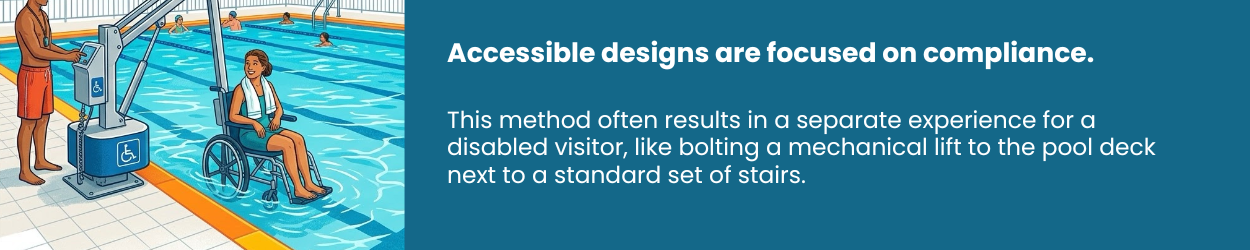
Accessible designs are focused on compliance. Following technical codes and standards, these designs are made with the intent that individuals with physical disabilities aren’t barred from entering a space. This design mindset is more focused on meeting the minimum needed for compliance vs. ideating innovative measures to ensure there is equality in the experiences of your visitors.
This method often results in a separate experience for a disabled visitor, like bolting a mechanical lift to the pool deck next to a standard set of stairs.
Durkin-Blackburn notes that this is the working vocabulary of the field: “The term typically used by practitioners who are responsible for design, construction, and maintenance of physical structures is ‘accessible’ or ‘ADA compliant.'” She’s found the industry is receptive to going further: “In conducting training for practitioners on the meaning of various terminology, I have never witnessed disagreement, just a willingness to learn and expand their knowledge.
- Universal Design
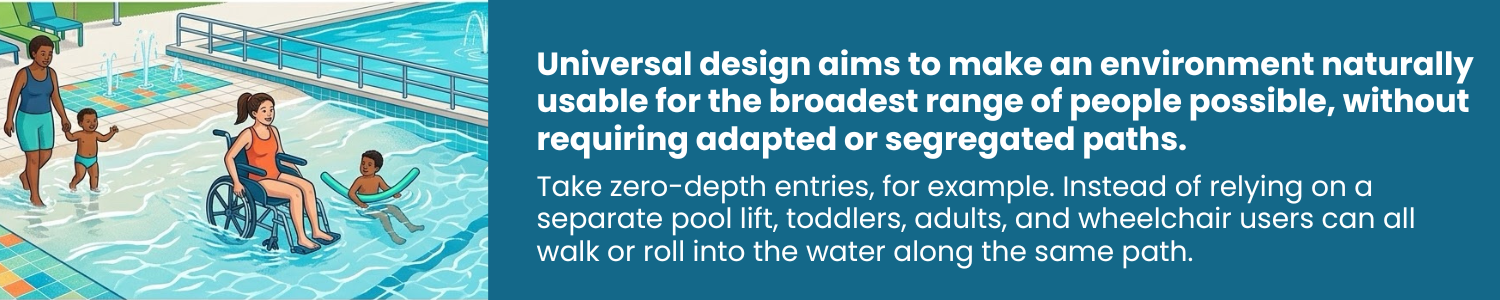
Universal design aims to make an environment naturally usable for the broadest range of people possible, without requiring adapted or segregated paths.
Take zero-depth entries, for example. Instead of relying on a separate pool lift, toddlers, adults, and wheelchair users can all enter the water along the same path.
- Inclusive Design
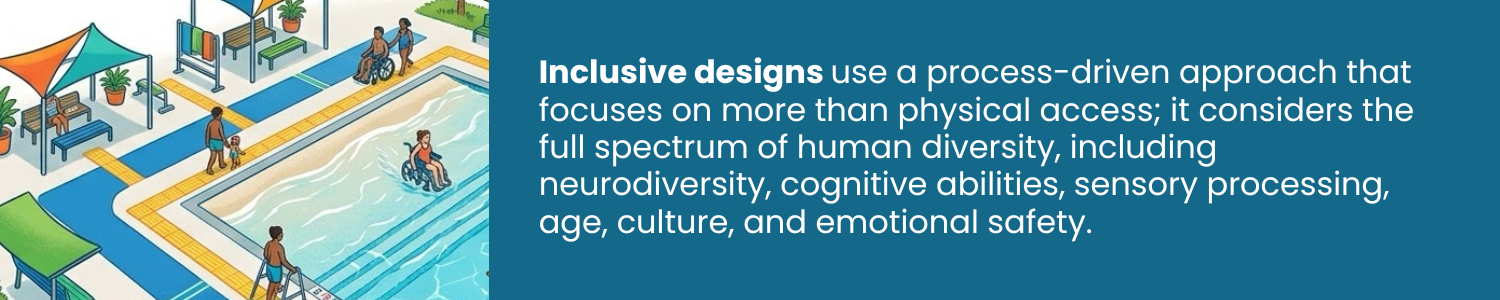
Inclusive designs use a process-driven approach that focuses on more than physical access; it considers the full spectrum of human diversity, including neurodiversity, cognitive abilities, sensory processing, age, culture, and emotional safety. The designs allow people to customize and adapt their experience to suit their specific needs.
For example, take that same zero-depth entry pool above. How does this experience feel socially and sensory-wise for someone with autism, dynamic mobility needs, or visual impairments? The resulting design could still feature the zero-depth entry, but include added shaded staging areas, gentle rest stations along the perimeter, color-coded visual cues, and tactile guidance pathing so guests with stamina or sensory differences feel confident and supported before and after getting in.
Innovations Making Waves in Aquatic Play
The modern aquatic industry is full of creative solutions that have helped transform standard features of aquatic experiences into incredible, all-ability splash zones. Here are some popping up in recent facility designs:
- Automatic & Adaptive Lifts: Modern pool lifts feature smooth, user-controlled operation, ergonomic seating, and discreet integration.
- Zero-Depth Entries: A universal feature for wave pools, splash pads, and leisure pools.
- Tactile Signage & Visual Guidance: High-contrast, textured maps and floor pathing that help visually impaired guests navigate around an aquatic play unit with ease.
- Aquatic-Grade AAC Boards: Weatherproof Augmentative and Alternative Communication (AAC) boards installed right at the edge of play areas. Non-verbal guests, young children, or non-native speakers can point to symbols to communicate “cold,” “help,” “more,” or “slide.”
- Zoned Sensory Play Areas: Rather than creating an entire play structure with loud noise and sudden dumps of water, strategic layout design splits attractions into distinct sensory zones:
- Dynamic Zones: Action-packed areas featuring big tipping buckets, water cannons, and more for thrill-seekers.
- Gentle / Tactile Zones: Lower-intensity spaces with soft misting features, ground jets, tables where guests can control the water flow at their own pace, and other solutions.
Bringing It All Together
Prioritizing inclusive design is a win for everyone. Guests of all abilities get to play side-by-side without barriers, while facilities can welcome larger crowds, keep families staying longer, and build lasting community loyalty.
Every inclusive park sets a new standard for the industry, pushing creators to build smarter, safer, and more thrilling attractions.
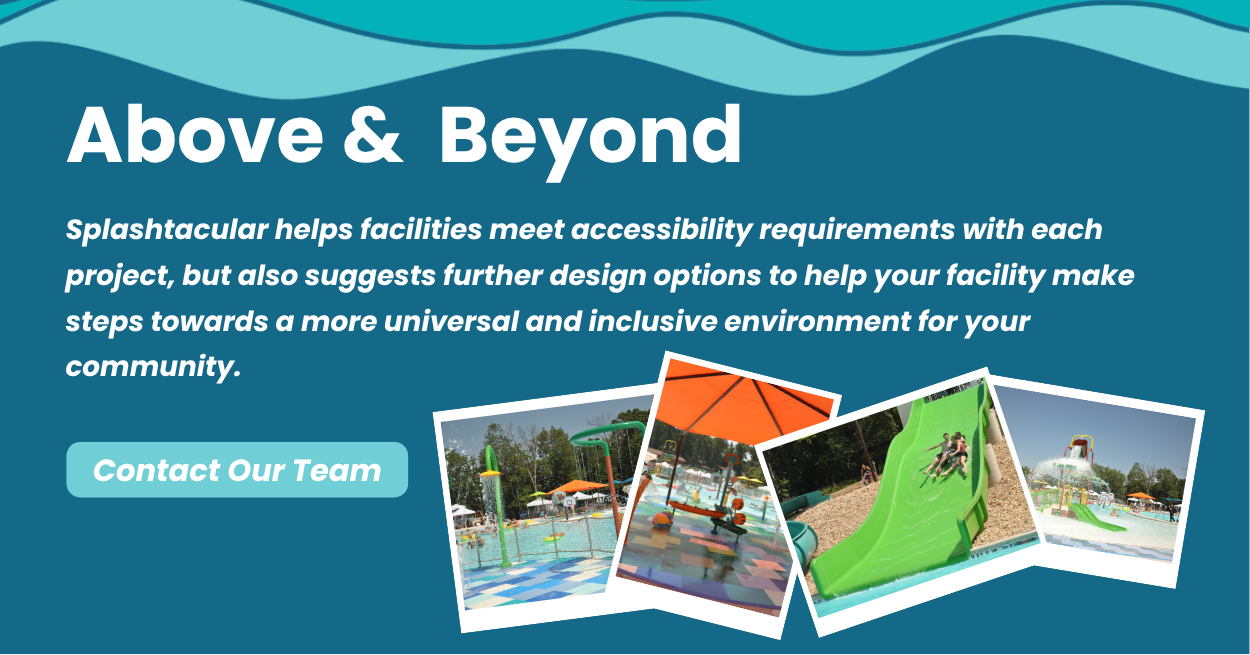
Ready to bring an accessible, aquatic structure to your community? Reach out to the team at Splashtacular today, and let’s turn your vision into an unforgettable splash zone!